

Primary Program Day One
Thursday 17 September, 4.30-6.30pm, online
Theme: Early Stage 1 and Stage 1
Time |
Speaker |
Topic |
| 4:30pm – 5:05pm |
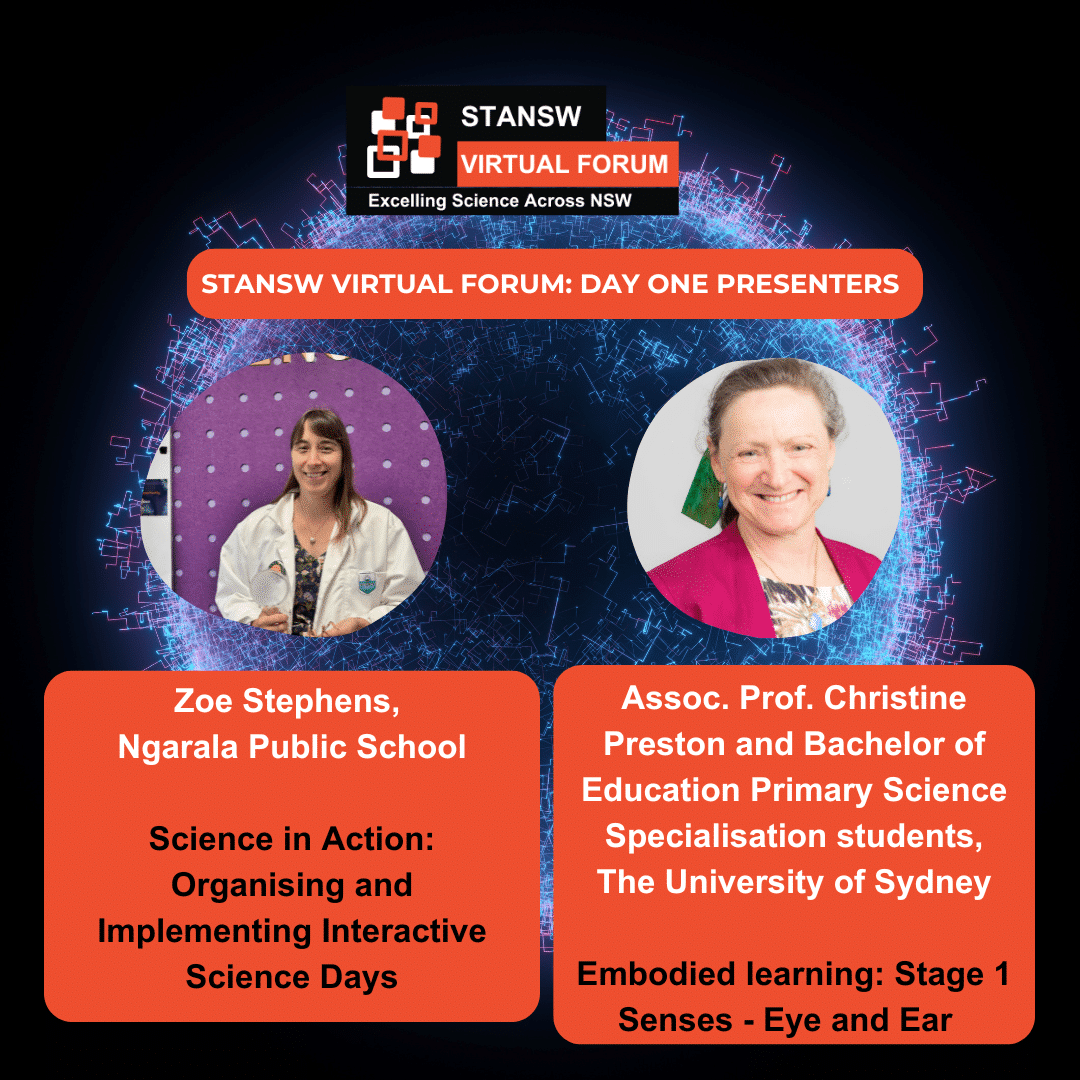
Zoe Stephens,Ngarala Public School |
Science in Action – Organising and Implementing Interactive Science DaysThis session will report on a project carried out at Ngarala Public School, in Epping. The Specialist Science teacher was tasked with designing and implementing a program of learning where lessons would be delivered to students from K-6 in a combination of individual classroom-based inquiry lessons and a whole stage interactive science experience. Zoe will outline the planning and preparation process for each interactive science day she implemented for Early Stage 1 and Stage 1, share some insights into the days and samples of student learning experiences. |
| 5:05pm – 5:15pm |
Break
|
|
| 5:15pm – 5:45pm |
Networking
|
|
| 5:45pm – 5:55pm |
Break
|
|
| 5:55pm – 6:30pm |
Assoc. Prof. Christine Preston, The University of Sydney, and Bachelor of Education Primary Science Specialisation students |
Embodied learning – Stage 1 senses: eye and ear.Preservice teachers from the University of Sydney who are completing the NESA Science and Technology K-6 Specialisation will present strategies suited to helping Stage 1 children understand fundamental aspects of how the eye and ear function to enable humans to see and hear. Students will demonstrate and discuss how embodied learning, where students use their own bodies as a form of representation, can support science understanding of abstract concepts. Students will identify critical concepts, critique standard diagrammatical representations and provide examples of age-appropriate activities for Stage 1 students. Participants will have the opportunity to discuss the affordances of embodied learning approaches. |
Primary Program Day Two
Thursday 8 October, 4.30pm – 6.30pm, online
Theme: Early Career Teachers Day
Time |
Speaker |
Topic |
| 4:30pm – 5:05pm |
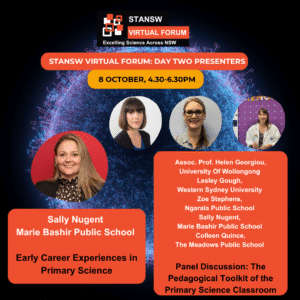
Sally NugentMarie Bashir Public School |
Early Career Experiences in Primary ScienceBeginning teachers are often expected to juggle a variety of curriculum demands while developing their professional confidence, engaging students and working with limited resources. This presentation reflects on the experience of becoming a specialist primary science teacher at a public school, exploring both the challenges and advantages of working across K–6 as an early-career educator. Drawing on personal experiences, the session will consider the realities of implementing hands-on learning and inquiry within busy primary school environments, as well as the unexpected lessons, tensions and opportunities that can emerge through science education as a beginning teacher. |
| 5:05pm – 5:15pm |
Break
|
|
| 5:15pm – 6:30pm |
Chair: Assoc. Prof. Helen Georgiou University of WollongongLesley Gough, Lecturer in Primary Science and Technology, Western Sydney UniversityZoe Stephens, Science Specialist, Ngarala PSSally Nugent, classroom teacher,Marie Bashir Public SchoolColleen Quince, The Meadows Public School |
Panel DiscussionIn this interactive panel discussion, we unpack the evolving pedagogical toolkit of today’s primary science classroom. Chaired by Dr. Helen Georgiou from University of Wollongong, the panel brings together a newly qualified teacher science specialist teacher, a mid‑career science specialist teacher, an early‑career primary generalist teacher and a lecturer in primary science education. Together, they will explore how teachers at different stages of their careers draw on — and continually reshape — their professional toolkit to meet the needs of diverse learners. Invitation for Questions: We invite members to shape the conversation by submitting questions in advance. Whether you’re curious about classroom practice, teacher development, or the future of science education, your voice will help guide the discussion. Share your questions via the panel question submission link. |
Primary Program Day Three
Thursday 15 October, 4.30pm – 6.30pm, online
Theme: Stage 2
Time |
Speaker |
Topic |
| 4:30pm – 5:05pm |
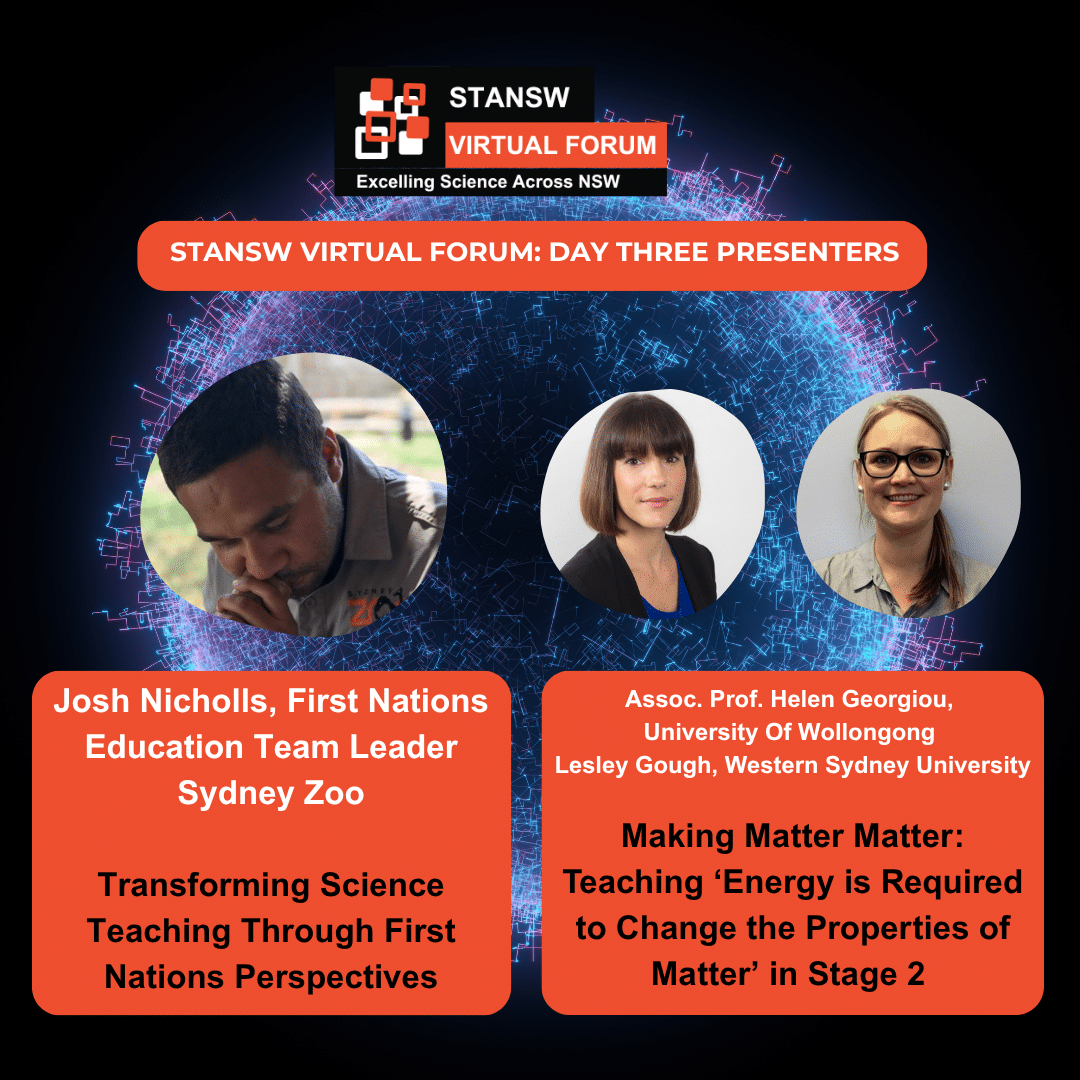
Helen Georgiou University of Wollongong
Lesley Gough, Lecturer in Primary Science and Technology, Western Sydney University |
Primary Particles – Making Matter, matter!The Stage 2 content group Energy is required to change the properties of matter introduces students to important scientific ideas about how materials change and behave in everyday situations. Underpinning this content are elements of the particle model of matter, a concept more commonly taught in secondary science. This session will explore the science behind the syllabus and highlight how these complex ideas can be taught in ways that are both meaningful and developmentally appropriate for Stage 2 learners. Unlike many resources and explanations that are aimed at high school students, this workshop focuses specifically on age-appropriate approaches for primary classrooms. Drawing on complementary expertise, Helen Georgiou, Associate Professor with a background in physics and science education, will unpack the key scientific concepts. Lesley Gough, an experienced primary educator and now Initial Teacher Educator, will share practical, classroom-tested strategies and learning experiences for Stage 2 students. Participants will leave with a stronger understanding of the scientific concepts required to teach this content group, and practical ideas to support confident implementation in their classrooms. |
| 5:05pm – 5:15pm |
Break
|
|
| 5:15pm – 5:45pm |
Networking
|
|
| 5:45pm – 5:55pm |
Break
|
|
| 5:45pm – 6:30pm |
Josh Nicholls, First Nations Education Team Leader Sydney Zoo |
Connecting with Country: Embedding First Nations Perspectives in Primary ScienceThis virtual session will be delivered by Sydney Zoo’s First Nation Team leader Josh Nicholls; he will support primary school teachers to meaningfully and respectfully include First Nations culture in their classroom. The session explores how First Nations perspectives can strengthen science learning by connecting students with Country, seasonal knowledge, sustainable land management, and the relationships between people, plants, animals, and place. |
Primary Program Day Four
Thursday 29 October, 4.30pm – 6.30pm, online
Theme: Stage 3
Time |
Speaker |
Topic |
| 4:30pm – 5:05pm |
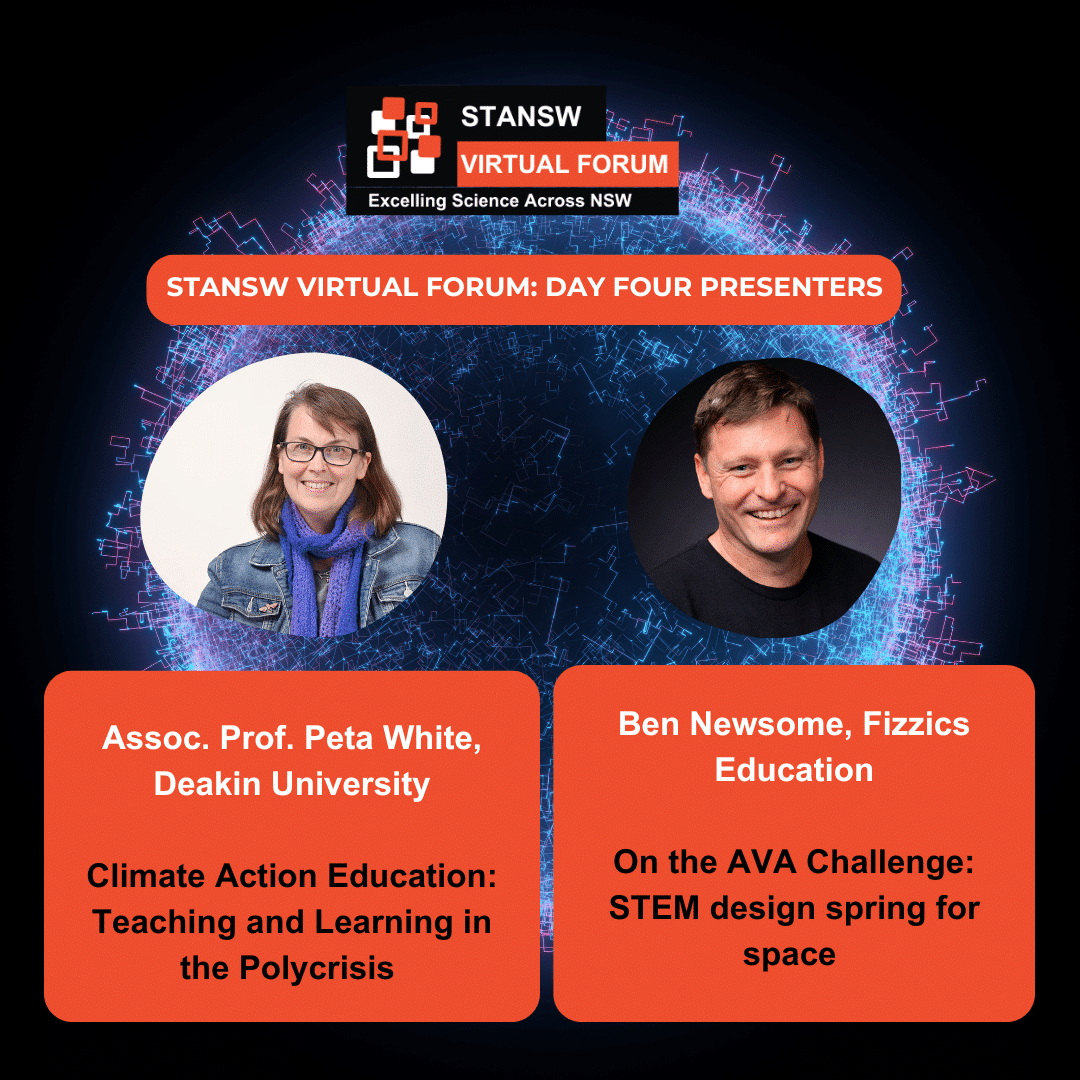
Assoc. Prof. Peta White, Deakin University |
Climate Action Education: Teaching and Learning in the PolycrisisThe Polycrisis is represented by human-induced climate change, biodiversity loss, plastic pollution and many more socio-ecological challenges that express themselves in various ways locally and globally. International policy has been developed that provides leverage in all education jurisdictions: the OECD PISA Science Framework 2025 with the support document ‘Agency in the Anthropocene’ and now the 2029 Climate Literacy Framework. Both policies will be unpacked in this presentation. Teaching and learning sequences co-designed for year 5 and 6 students by our research team, scientists, teachers, and students will exemplify how to offer climate action education. We know that young people have strong desires to understand what is happening and why as well as how to take action to transform our societies for regenerative futures. Teaching and learning for regenerative futures requires responsible decision making and agency from teachers and students in informed education systems. |
| 5:05pm – 5:15pm |
Break
|
|
| 5:15pm – 5:45pm |
Networking
|
|
| 5:45pm – 5:55pm |
Break
|
|
| 5:45pm – 6:30pm |
Ben Newsome, Fizzics Education |
On the AVA Challenge – STEM design spring for spaceDiscover the AVA Challenge, a STEM design sprint designed in partnership with the NSW Dept. of Education STEM enrichment team. In this session, you will learn how your students will apply design thinking and the engineering design process to solve known NASA shortfalls for the Artemis missions and pitch these to the Australian Space Industry, all guided by a comprehensive and free unit of work. https://avachallenge.org/ |
Primary Pricing Per Person
| Single Day |
Full Series | |
| Primary Member | $65 | $125 |
| Pre-service Member | $30 | $55 |
| Non-Member | $120 | $180 |
To register, see our Learning & Events Calendar.
Professional Learning Hours
STANSW is a NESA recognised provider. This professional learning may be logged as accredited professional development hours toward proficient teacher accreditation. Standards addressed: 1, 2, 3, 5, 6 and 7.