

Secondary Program Day One
Thursday 17 September, 4.30-6.30pm, online
Theme: Depth Studies
Time |
Speaker |
Topic |
| 4:30pm – 5:05pm |
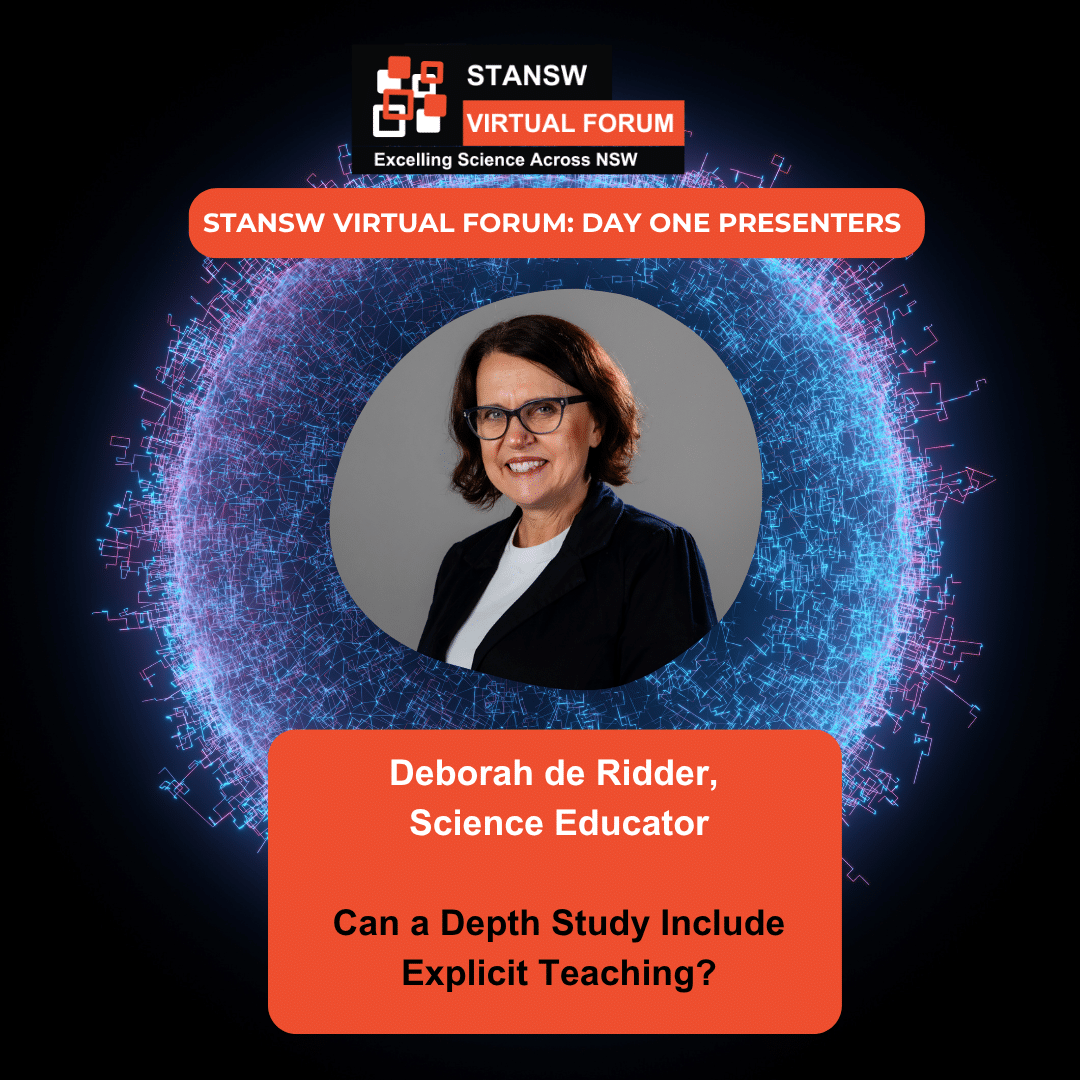
Deborah de Ridder, Science Educator |
Can a Depth Study include explicit teaching?The move towards explicit teaching practices has left science teachers a little perplexed about the place of science inquiry and the teaching of practical science. This session presents a guided planning approach to teaching the Depth Study based on research findings which also includes explicit teaching. A planning model proposes five planning stages and tips on differentiating the level of guidance to support your classroom practice. This presentation is designed so that you can reflect on your current classroom practice and potentially try some additional teaching approaches including scaffolding, questioning, and prompting. |
| 5:05pm – 5:15pm |
Break
|
|
| 5:15pm – 5:45pm |
Networking
|
|
| 5:45pm – 5:55pm |
Break
|
|
| 5:55pm – 6:30pm |
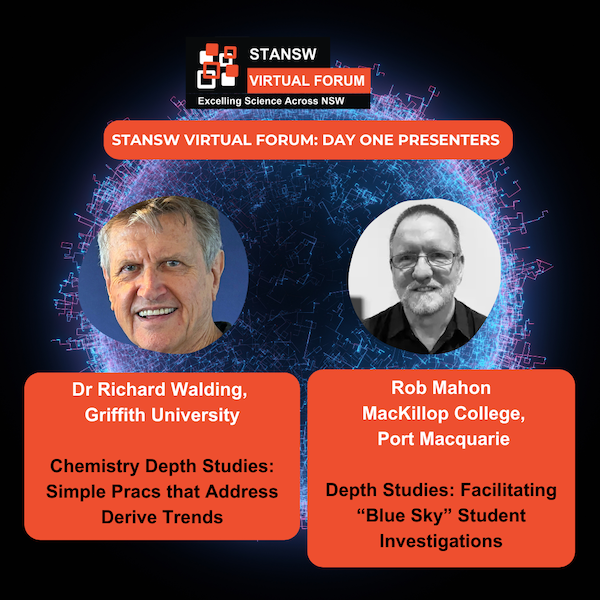
Dr Richard Walding, Griffith University |
2 Concurrent Depth Studies sessions:
Chemistry Depth Studies: Simple pracs that address derive trends.Dr Richard Walding will present several chemistry pracs in acid-base reactions that work well in addressing the ‘derive trends’ aspect of Band 6 criteria in the 2025 NSW Chemistry syllabus. Schools in rural and remote often struggle with practical aspects of the syllabus if they don’t have adequate resources. Teachers often worry that the new practicals will be manageable but will require buying chemicals that school labs don’t use. However, the experiments Richard is presenting are not overly complex. In fact, they are simple pracs that need little equipment and can be done in any school in the State. The important part is how the collected data can be graphed to show patterns and relationships, and derive trends, so necessary to allow for a good depth of thinking. Richard will show the setup of the pracs and what concentrations, volumes and equipment works best. Teachers will leave with a variety of ready-to-go pracs that lab staff will have little trouble setting up, and that students will understand how to perform them, what to look out for, and the best approaches for analysis of data and its limitations.
|
| 5:55pm – 6:30pm |
Rob Mahon, MacKillop College Port Macquarie |
Depth Studies: Facilitating ‘Blue Sky’ student investigationsThe mandatory depth study components of both the Preliminary and HSC science courses are an intimidating obstacle for many teachers. In an attempt to manage the many moving parts of these, some teachers enforce greatly constricted choices or a specifically mandated topic of depth study for all students to focus on. This restriction of student choice goes against the principles behind the depth study investigation. This workshop looks at ways to open up the bottleneck around student choice in depth study selection. In the preliminary depth study session, we will look at ways to offer a large menu of choices for students to create a physical model with working components and a digital overlay of both curated and created content. In the HSC depth study session, we will look at how to offer a “Blue Sky” range of primary or secondary investigations. In both sessions we will provide marking rubrics which allow for clarity of marking and fair comparison and across a wide range of student choices. |
Secondary Program Day Two
Thursday 8 October, 4.30pm – 6.30pm, online
Theme: Depth Studies 2
Time |
Speaker |
Topic |
| 4:30pm – 5:05pm |
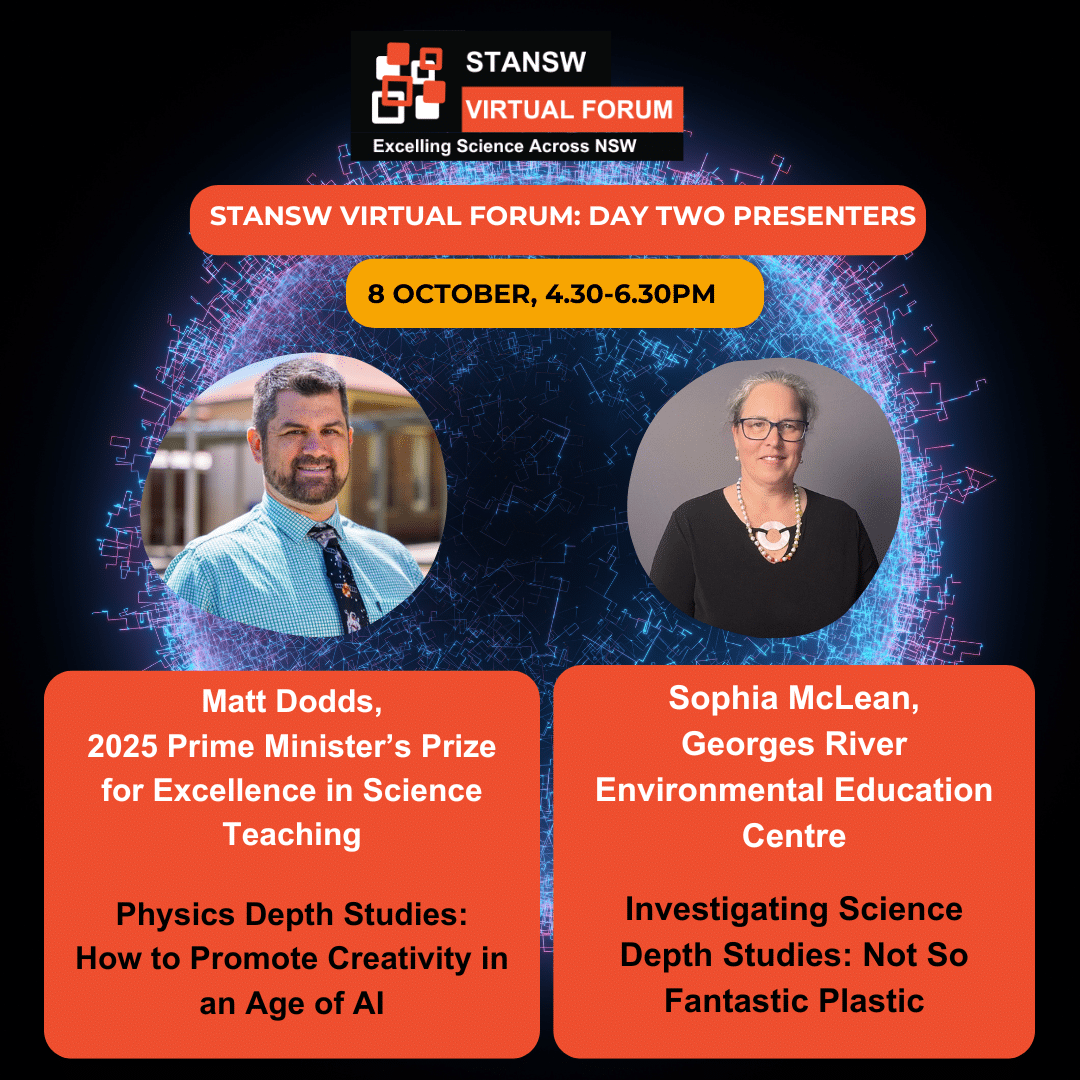
Matt Dodds, Winner of the 2025 Prime Ministers Prize for Science Teaching in Secondary Schools
|
2 Concurrent Depth Studies sessions:
Physics Depth Studies: How to Promote Creativity in an Age of AI.I.Join Matt to learn how he encourages students to think creatively for their Depth Studies in Physics. For many years now he has encouraged his students to become masters of their own learning by reflecting upon what they have learnt and creating a Physics Teaching tool used to instruct the rest of the class. Previous student projects include DC Motors, AC Induction Motors, DC Generators and even a working replica of the original Michael Faraday Motor.
|
Sophia McLean, Georges RiverEnvironmental Education Centre |
INS Depth Studies, Not So Fantastic PlasticPlastic is perhaps the greatest environmental catastrophe after climate change. Most of the solutions are sadly greenwashing. In this workshop we will explore what plastic is, the problems with it in the environment and what happens when microplastics enter organisms. We will explore a range of activities suitable for any age group as well as scientific sampling methods for microplastics as conducted by AUSMAP – the Australian Microplastics Assessment Project. Participants will get to sort a microplastic sample from one of the worst hotspots in Sydney. A range of sustainability solutions will be explored from the very simple to ones that require a bit more effort. |
|
| 5:05pm – 5:15pm |
Break
|
|
| 5:15pm – 5:45pm |
Networking |
|
| 5:45pm – 5:55pm |
Break
|
|
| 5:55pm – 6:30pm |
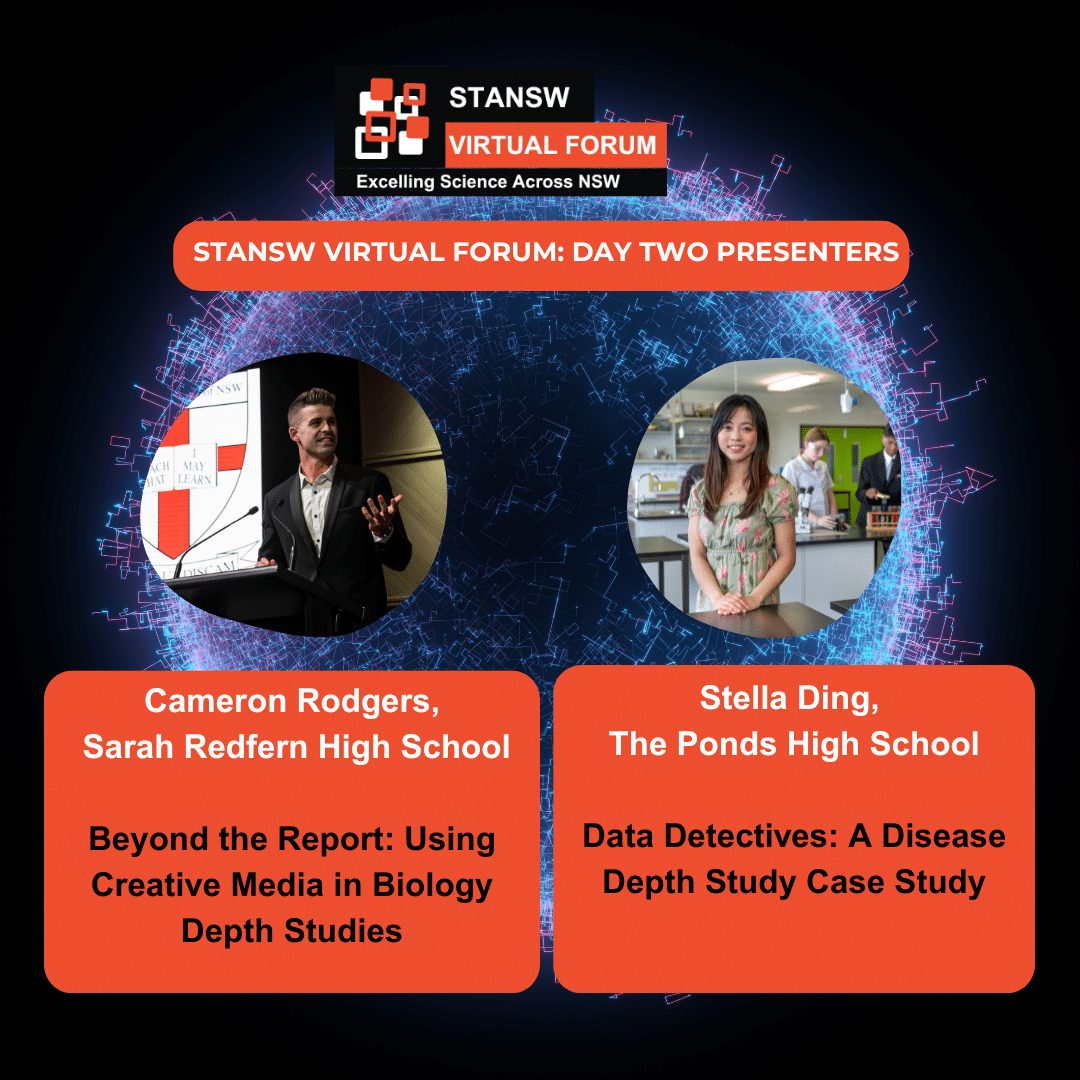
Cameron Rodgers, Sarah Redfern High School |
2 Concurrent Depth Studies sessions:Beyond the Report: Using Creative Media in Biology Depth StudiesBiology Depth Studies offer students the opportunity to engage in authentic scientific inquiry, yet many still culminate in traditional written reports or presentations. This session explores how creative media (including documentary filmmaking, digital storytelling, podcasts and short-form video) can be used to transform Biology Depth Studies into engaging, authentic and future-focused learning experiences. Participants will examine how media-rich assessment tasks can maintain scientific rigour while providing students with opportunities to communicate biological concepts to real audiences. Drawing on classroom examples and emerging research in conservation education, this presentation will demonstrate how creative media can enhance student engagement, strengthen scientific communication skills and support deeper understanding of complex biological concepts. Attendees will leave with practical ideas for implementing creative media projects within existing Biology programs, along with strategies for ensuring strong alignment to syllabus outcomes, assessment requirements and inquiry-based learning principles. The session is suitable for Biology teachers, curriculum leaders and educators interested in innovative assessment practices.
|
| 5:55pm – 6:30pm |
Stella Ding, The Ponds High School |
Data Detectives: A Disease Depth Study Case StudyThis knowledge-sharing session explores practical implementation of a Stage 5 Depth Study aligned to the 2023 NSW Department of Education Science Syllabus. The focus is on strengthening student skills in modelling and graphing with real-world disease data, with explicit teaching strategies embedded throughout the unit to support skill development and conceptual understanding. Participants will examine how the depth study is structured, how modelling and data representation skills are explicitly taught and scaffolded, and how assessment opportunities are integrated. The session will highlight practical classroom strategies, differentiation approaches, and ways to build student confidence in interpreting and constructing graphs and scientific models. By the end of the session, participants will have a clear framework for implementing a Stage 5 depth study, along with adaptable resources and teaching strategies that can be immediately applied in their own classrooms. |
Secondary Program Day Three
Thursday 15 October, 4.30pm – 6.30pm, online
Theme: Aboriginal and Torres Strait Islander Perspectives
Time |
Speaker |
Topic |
| 4:30pm – 5:05pm |
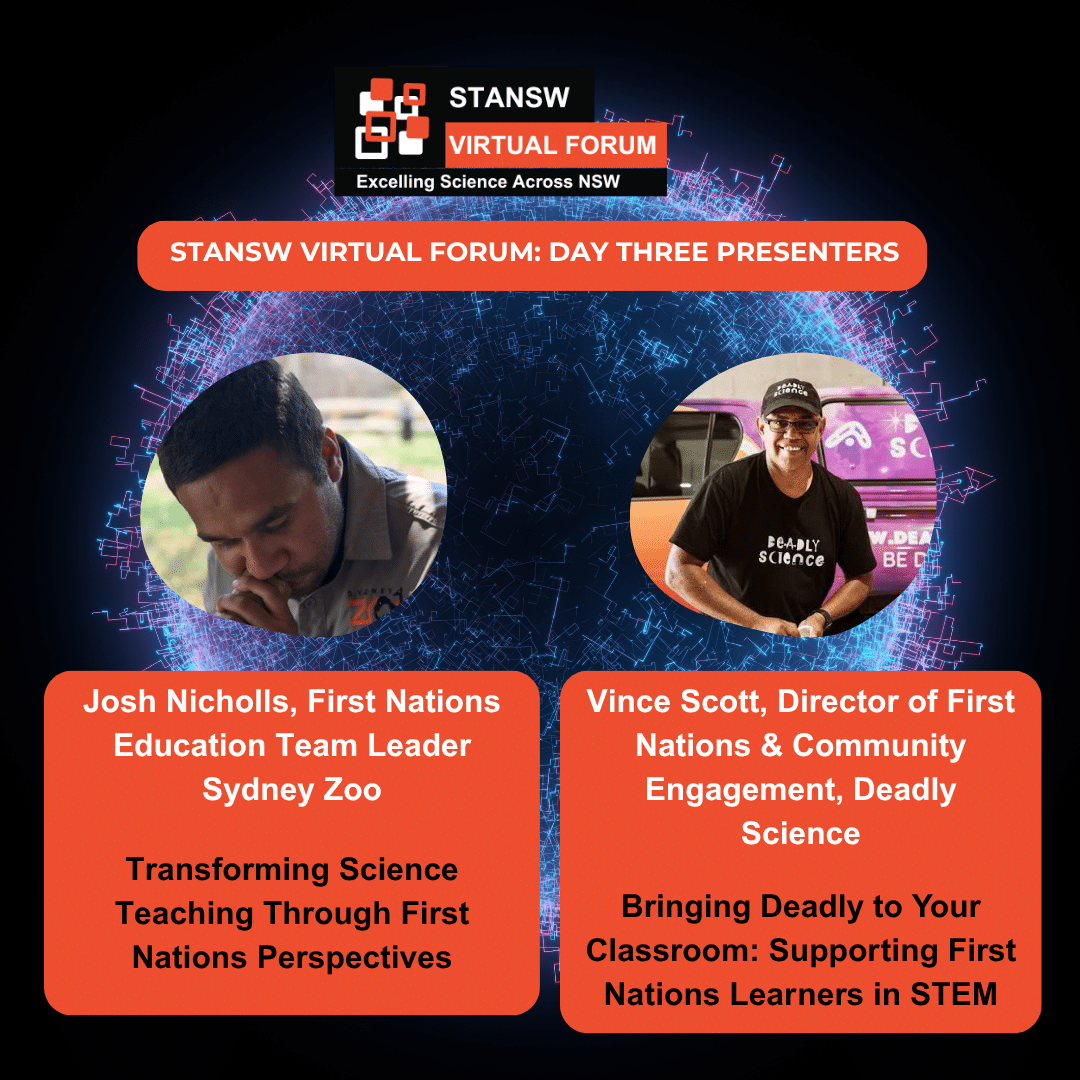
Josh Nicholls, First Nations Education Team Leader Sydney Zoo
|
Transforming Science Teaching Through First Nations PerspectivesThis virtual session explores how science teachers can authentically address syllabus outcomes while embedding First Nations perspectives. Using the Sydney Zoo workshop “Aboriginal Astronomy” as an example, this session highlights the deep scientific knowledge systems developed by First Nations peoples over tens of thousands of years. |
| 5:05pm – 5:15pm |
Break
|
|
| 5:15pm – 5:45pm |
Networking
|
|
| 5:45pm – 5:55pm |
Break
|
|
| 5:15pm – 6:30pm |
Vince Scott, Deadly Science |
Bringing Deadly to Your Classroom: Supporting First Nations Learners in STEMHow do we make STEM classrooms genuinely welcoming and effective spaces for First Nations learners? In this session, Vinnie draws on Deadly Science’s experience working with schools and communities across Australia to share practical, culturally safe strategies for embedding First Nations knowledge into STEM teaching, using examples such as Engineering of Fish Traps and Chemistry of Bush Soap. Participants will explore how to support First Nations students’ engagement and success in STEM, alongside approaches for respectfully and confidently incorporating First Nations perspectives and knowledge systems into everyday classroom practice.
|
Secondary Program Day Four
Thursday 29 October, 4.30pm – 6.30pm, online
Theme: Data Science
Time |
Speaker |
Topic |
| 4:30pm – 5:05pm |
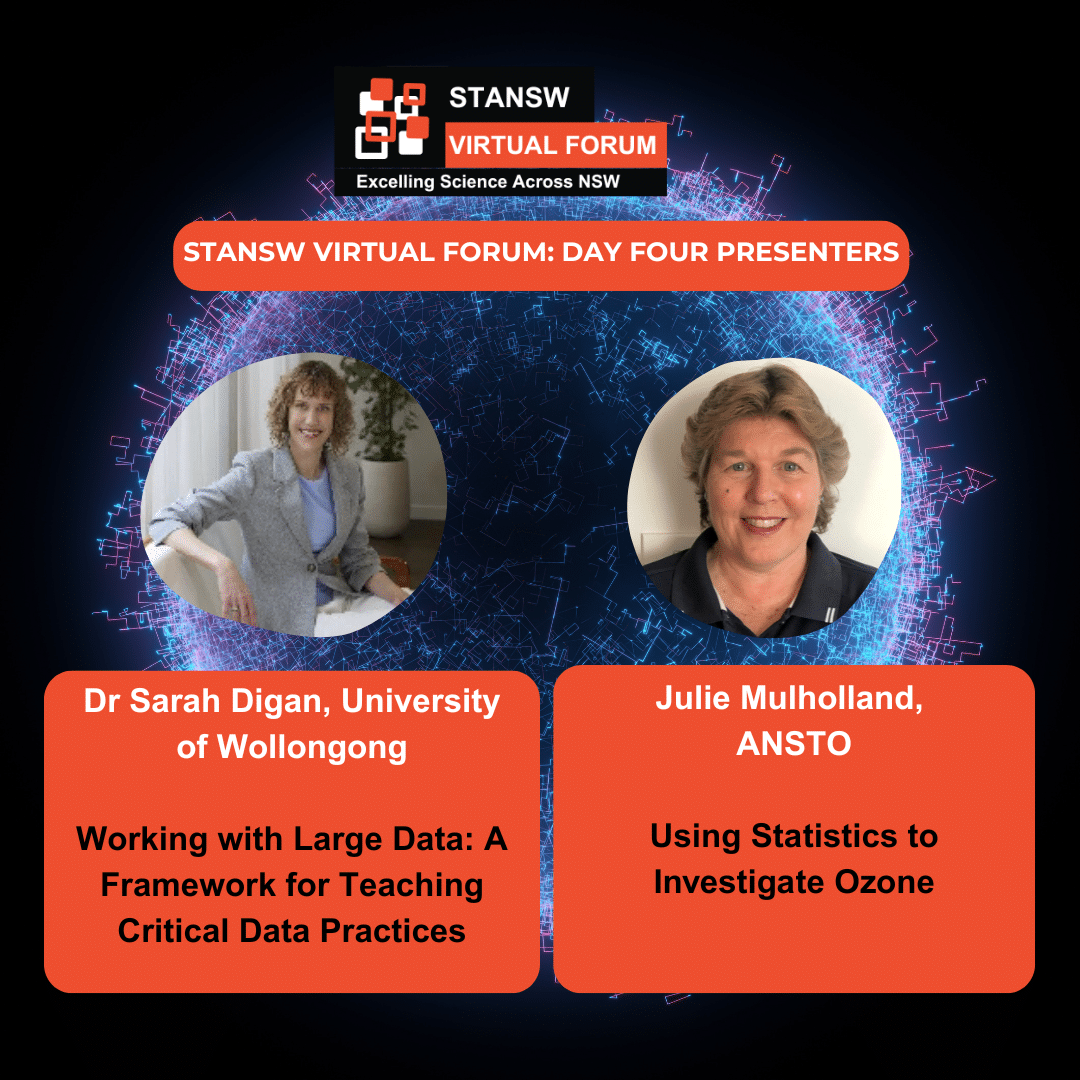
Dr Sarah Digan, University of Wollongong
|
Working with large data: A framework for teaching critical data practicesThe new NSW Science 7-10 Syllabus (2023) places ethical, evidence-based decision-making with data as a core requirement of the new mandatory Data Science focus areas. Yet what this looks like in a secondary classroom – what practices students need, how those practices connect, and how teachers can facilitate and assess them – is an area where both research and practical guidance remain limited. This workshop offers a research-grounded framework for understanding and teaching critical data practices in secondary science. Drawing on an emerging model of evidentiary data practices (Unshelm et al., 2025; Digan et al., under review), we examine what these practices look like in secondary classrooms and what changes when generative AI becomes part of the process. The framework is illustrated through two publicly available tasks using real occurrence and climate data from the Illawarra and large global poverty datasets. Participants will engage with elements of both tasks, work with the framework as an analytical and design tool, and discuss how to adapt these ideas across their own teaching contexts. Both tasks and supporting materials will be provided to all participants. |
| 5:05pm – 5:15pm |
Break
|
|
| 5:15pm – 5:45pm |
Networking
|
|
| 5:45pm – 5:55pm |
Break
|
|
| 5:15pm – 6:30pm |
Julie Mulholland, ANSTO |
Using statistics to investigate ozoneWhile ozone gas is crucial in the upper atmosphere to block harmful UV, ozone in the air we breathe can irritate our airways and exacerbate chronic conditions like asthma. This data set investigates the relationship between ozone concentration, other pollutant gases, and temperature. Students are introduced to basic statistics, including univariate and bivariate analyses, and concepts such as mean, median, maximum, minimum, standard deviation, quartiles and outliers.
|
Secondary Pricing Per Person
| Single Day |
Full Series | |
| Individual Secondary Member | $80 | $155 |
| Secondary School Member | $95 | $185 |
| Pre-service Member | $30 | $55 |
| Non-Member | $240 | $475 |
To register, see our Learning & Events Calendar.
Professional Learning Hours
STANSW is a NESA recognised provider. This professional learning may be logged as accredited professional development hours toward proficient teacher accreditation. Standards addressed: 1, 2, 3, 5, 6 and 7.