
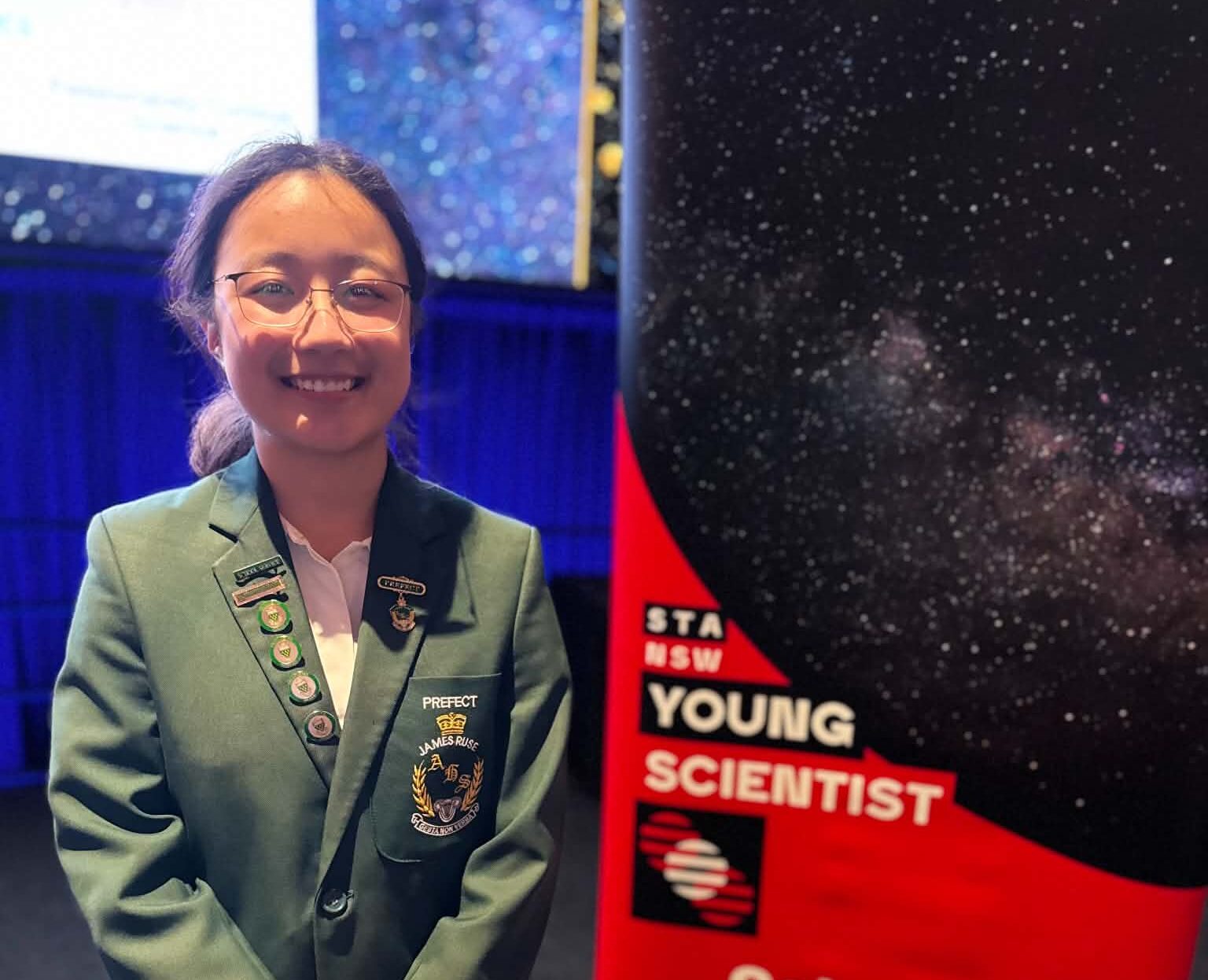
The next generation of Australian scientists has been recognised at the 2026 NSW Young Scientist Awards Ceremony, with James Ruse Agricultural High School student Flora Li taking home the prestigious title of Young Scientist of the Year.
Flora was recognised for her project, Per-State Stochastic Compartmental Retrospective Modelling of the Effects of Vaccine Hesitancy Upon COVID-19 Infection Incidence and Mortality in Australia.
Austin Harrington from Lambton High School in Newcastle came in second place for his project Influence of Acid Pre-Treatment and Solution pH on Copper(II) Ion Adsorption by Sugarcane Bagasse-Derived Biochar.
Rural Young Scientist of the Year went to Audrey Pearce, from Kinross Wolaroi School in Orange, for her project Birth Type Effects on Fertility and Prolificacy in Adult Merino Ewes, and Beau Hill, Armidale Secondary College, for his project TARES (Tow Assessment Risk Estimation System).
The major Climate Action Award was awarded to Zoey Liu and Angelina Li from North Sydney Girls High School, alongside James Chen from North Sydney Boys High School, who collaborated on WiFire, an innovative project recognised for its technological creativity and problem-solving. The runner up Climate Action Award went to Caitlin Chee from St Catherine’s School for her project Comparing the effect of acid-catalysed, base-catalysed and neutral hydrolysis on the degradation of solid Polylactic Acid (PLA).
Held at University of Technology Sydney (UTS) on Friday 27th November, this marked the 66th year of the Young Scientist Awards Program, a state-wide competition that celebrates scientific and technical innovation of K-12 school students around NSW. Since 1960, the program, run by the Science Teachers’ Association of New South Wales (STANSW), has encouraged students to undertake innovative projects and investigations to find creative solutions to real-world problems.
This year’s competition attracted more than 500 project entries from Kindergarten to Year 12 students across NSW. Sydney’s Inner West was the most highly awarded region, followed by Parramatta and North Sydney. A record number of over 150 monetary prizes totalling over $24,000 were awarded to students for their innovative science projects across the categories of Earth and Environmental Science, Physics, Biology, Chemistry, Scientific Investigation, Technological Innovations and Climate Action.
Vice President of The Science Teachers’ Association of New South Wales, Dr Lauren McKnight, says the Young Scientist Awards provide a platform for students to showcase their scientific curiosity, thinking and creativity.
“Climate Action is a significant theme this year, with a dedicated category offering more than $6,000 in sponsored prizes. The category encourages students to develop innovative solutions to reduce greenhouse gas emissions while highlighting the important role of science and technology careers in Australia’s transition to a net zero future,” Dr McKnight said.
“It’s incredible to see student curiosity and interests come to life through scientific investigation. This year we’ve seen students test solutions to real-world challenges, from assistive technologies and safety systems to bridges, turbines, robotic devices and vehicle aerodynamics.
“Other projects investigate microplastics in freshwater and soils, rubber crumb pollution, antimicrobial resistance in the environment, water quality, groundwater recharge and effects on plant growth. It shows just how passionate and bright our young minds are.”
“These experiences help young people see science not just as a subject, but as a way of understanding and shaping the world around them. By celebrating their achievements, we’re recognising the creativity, persistence, and critical thinking that fuel Australia’s future innovation.”
The program now accepts a broader range of submission formats alongside traditional written reports, recognising that students communicate scientific investigations and technological innovations in different ways. This makes the competition more accessible and encourages even more students to participate.
This year’s Young Scientist Awards are supported by program sponsors including University of Technology (UTS), Powerhouse, Rowe Scientific, Australian Skeptics, Anzu Education, AIP, RACI and Passionately Curious.
After the Young Scientist Awards Ceremony, selected students from each region of NSW will be invited to represent the state at the Australia Wide Science Fair – The ASTA iCubed Awards. Senior students are also invited to contribute to The Young Australians Science Journal (YASJ).
About the Science Teachers’ Association of NSW
Founded in 1951, the Science Teachers’ Association of NSW (STANSW) is committed to advancing the profession of science education in New South Wales, with a focus on the professional learning, support, and advocacy of its teacher members.
Embracing the passion of science educators who volunteer their time, the association provides leadership and support to its members. As education systems and pedagogy evolve, STANSW strives to serve as a voice for our teacher members, providing them with the support and guidance required to adjust to change and consistently deliver excellence in science teaching.