
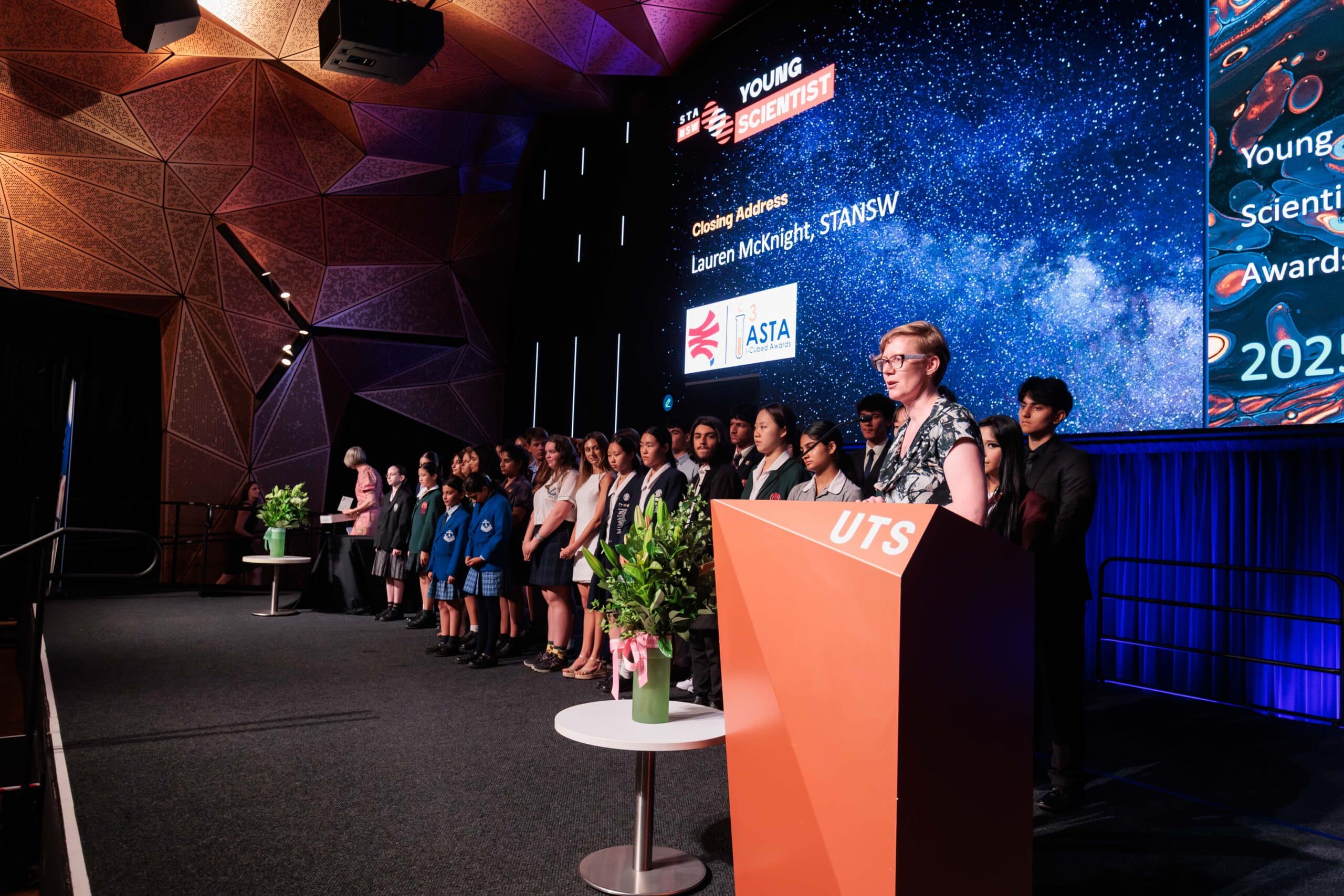
NSW schools have until the end of August to enter the 2026 Young Scientist Awards, with a new Climate Action category encouraging students to develop solutions for Australia’s net zero future.
This year will be the 66th year of the Young Scientist Awards Program, a state-wide competition that celebrates scientific and technical innovation of K-12 school students around NSW. Since 1960, the program, run by the Science Teachers’ Association of New South Wales (STANSW), has encouraged students to undertake innovative projects and investigations to find creative solutions to real-world problems.
More than 150 monetary prizes will be awarded to students for their innovative science projects this year, with the prestigious titles of Young Scientist of the Year and Rural Young Scientist of the Year to be awarded alongside category prizes – Earth and Environmental Science, Physics, Biology, Chemistry, Scientific Investigation, Technological Innovations and Climate Action, open to students across all stages.
The Climate Action category has been introduced to encourage students to develop solutions for reducing greenhouse gas emissions while highlighting the importance of science and technology careers supporting Australia’s transition to a net zero future.
Schools, teachers and parents have until the end of August to upload projects through the Young Scientist website for the chance to be recognised among NSW’s leading young scientists.
Vice President of The Science Teachers’ Association of New South Wales, Dr Lauren McKnight, says the Young Scientist Awards provide a platform for students to showcase their scientific curiosity, thinking and creativity.
“Through the Young Scientist Awards, students engage with authentic practices of science. They ask questions, test ideas, and put their scientific skills into action. In doing so, they create something genuinely unique, driven by curiosity and the desire to explore the unknown.
“These experiences help young people see science not just as a subject, but as a way of understanding and shaping the world around them. By celebrating their achievements, we’re also recognising the creativity, persistence, and critical thinking that fuel Australia’s future innovation.”
“The program now accepts a broader range of submission formats alongside traditional written reports, recognising that students communicate scientific investigations and technological innovations in different ways. This makes the competition more accessible and encourages even more students to participate.”
The Young Scientist of the Year and winners will be announced at the ceremony at the University of Technology in November 2026, as well as on the Science Teachers’ Association of New South Wales website: www.stansw.asn.au.
After the Young Scientist Awards Ceremony, selected students from each region of NSW will go on to represent the state at the National Science Awards – The iCubed Awards.
This year’s Young Scientist Awards is supported by program sponsors: University of Technology (UTS), Powerhouse, Anzuk Education, Australian Skeptics, Rowe Scientific, and Passionately Curious.
Resources and guidelines can be found on the Young Scientist website, where projects can also be submitted: https://youngscientist.au/